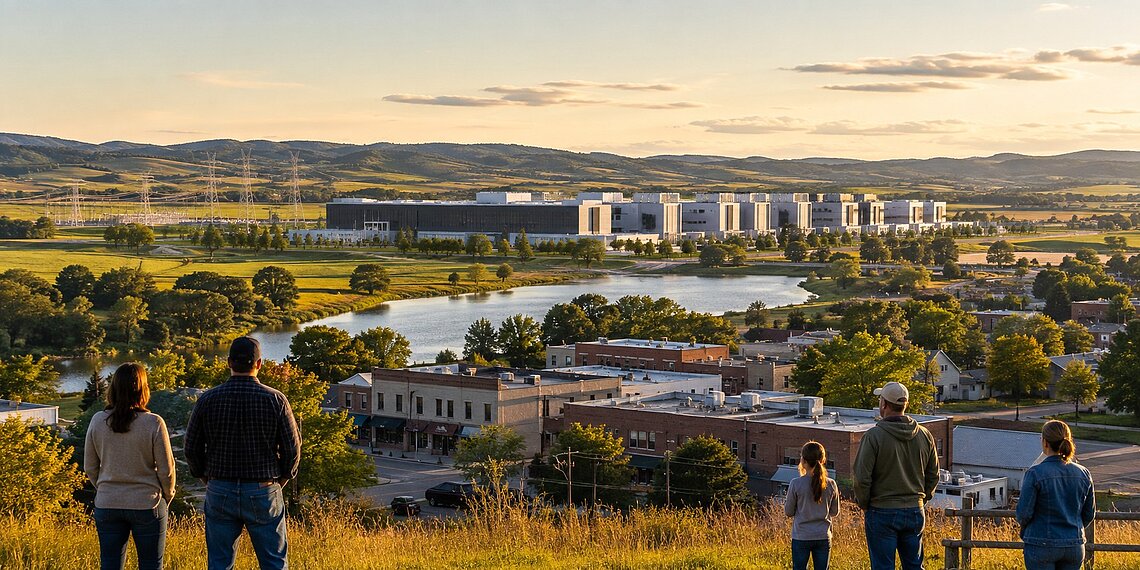
Across the United States, proposals for new data centers are creating a profound divide. Supporters see them as critical infrastructure that America must build to remain economically and technologically competitive, particularly in an intensifying race with China. Opponents see enormous facilities consuming local resources, replacing farmland and potentially increasing utility costs while creating relatively few permanent jobs.
My decision to write this column was prompted by several recent conversations with chamber leaders across different states who are already confronting questions about data centers, artificial intelligence and their effects on local communities. Those conversations revealed both legitimate excitement and genuine concern. They also exposed a need for chambers to evaluate these projects thoughtfully, objectively and before community positions become firmly divided.
Both sides have legitimate points. That is precisely why chambers of commerce should be involved in the conversation.
I do not approach this issue as an opponent of artificial intelligence. My company uses AI, develops AI-supported solutions and helps chambers prepare for a more technology-driven future. AI allows us to research, create, analyze and develop certain products more efficiently than we could before.
I also recognize the irony of writing about artificial intelligence while using it within my own business. I have spent decades as an educator, business owner and community leader, and I possess both the formal education and professional experience to develop and express my own conclusions. AI may assist with research, organization and productivity, but it did not give me the experiences, concerns or convictions reflected in this column. Those are distinctly my own.
At the same time, I own a small digital-services company employing middle-class professionals whose work is increasingly being replicated, accelerated or commoditized by the same technology.
The data centers being proposed in American communities may power tools that help my company grow. They may also power tools that make portions of my company’s work obsolete.
Website development, programming, content writing, graphic design, search optimization, customer support and marketing are already being changed by AI. My concern is not limited to whether AI can completely replace a company like mine. The more immediate danger may be that prospective customers begin to believe professional experience, personal service and human judgment are no longer necessary because an AI platform can generate something faster and cheaper.
Nor is my connection to this debate limited to my business. I come from rural “Small Town, USA,” with family roots in close-knit communities and farming regions. I still return home to hunt, enjoy the outdoors and reconnect with the places and people that shaped me. I understand why residents are protective of the land, natural resources and character of their communities because I share that connection.
That makes this debate neither theoretical nor comfortably one-sided for me.
It also illustrates an important distinction. The potential displacement of middle-class workers by artificial intelligence and the local economic impact of a data center are related, but they are not the same issue.
A data center does not directly eliminate the job of an accountant, designer, programmer or marketing professional. It provides the computing infrastructure that makes increasingly capable AI systems possible. Conversely, thousands of temporary construction jobs associated with a data center do not necessarily offset the permanent jobs that AI could eventually disrupt throughout the economy.
Current evidence does not prove that AI will eliminate small businesses or cause widespread unemployment. An OECD study of small and medium-sized businesses found that 83 percent of those using generative AI reported no change in their overall staffing needs. Nine percent reported a decrease, while six percent reported an increase. AI is helping many smaller businesses become more productive and compensate for workforce and skill shortages.
Nevertheless, the competitive transformation has clearly begun. Businesses that learn to use AI will have advantages over those that do not. Some positions will change. Some will disappear. Others will be created. Chambers should therefore treat AI workforce preparation as an immediate economic-development responsibility, not a distant technology issue.
A National Need with Local Consequences
There is a strong national argument for building AI infrastructure in the United States.
Artificial intelligence already influences national defense, cybersecurity, medical research, manufacturing, logistics, education and nearly every sector of the economy. Its influence will only continue to expand. The United States cannot reasonably decide to abandon the physical infrastructure required to support that development and assume there will be no economic or national-security consequences.
But national importance should not become a blank check written against local communities.
According to the U.S. Department of Energy, data centers consumed approximately 4.4 percent of all electricity used in the United States in 2023. That share is projected to reach between 6.7 and 12 percent by 2028. Meeting that demand may require new generation facilities, transmission lines, substations and other costly infrastructure.
The critical local question is not merely whether the electrical grid can accommodate a proposed data center. It is who will pay for the additional capacity and whether residential customers and existing small businesses will be protected from those costs.
Water requires equally careful examination, although the answer is more complicated than declaring that every data center consumes an excessive amount.
Some cooling systems recirculate water through closed loops. Others rely upon cooling towers that reuse water for multiple cycles but continually lose some of it through evaporation. Those systems also periodically discharge water as minerals and contaminants become more concentrated. Dry or air-cooled systems can substantially reduce water consumption, but they may require more electricity, cost more or operate less efficiently during extremely hot weather.
Facilities may also be able to use reclaimed wastewater, captured rainwater or other nonpotable sources rather than drinking water.
Consequently, asking whether cooling water is “reused” is not enough. Communities should ask how much water will be withdrawn, how much will be returned, how much will be lost through evaporation, what percentage will be potable water and what happens during a drought.
Land use must be considered with the same level of precision. Large developments can generate revenue for landowners and local governments. They can also permanently remove productive agricultural land, alter the character of rural areas and limit future development alternatives. A location that makes sense on previously developed industrial property may have a very different community impact when placed on hundreds or thousands of acres of productive farmland.
These concerns do not automatically justify rejecting a project. They justify thoroughly evaluating it.
A Chamber’s Proper Role
Chambers of commerce will not be immune to the effects of AI or the infrastructure required to support it. A chamber is not merely an office, a board or a staff. It is the collective voice of its businesses and the people behind them: employers, employees, entrepreneurs, property owners and families who live within the community. When they are affected, the chamber is affected.
That is why chambers should become involved before positions harden, promises are accepted as facts or major decisions have already been made. The chamber’s proper role is to bring business leaders, residents, utilities, educators, farmers, developers and public officials to the same table. It should separate verifiable benefits from promotional promises and help determine whether a proposal strengthens the community over the long term.
A chamber of commerce should not serve as the automatic cheerleader for every project carrying a large investment figure. It should not reflexively join the opposition, either.
Before supporting a project, chamber leaders should know how many jobs will exist during construction and how many will remain after the facility opens. They should know what those permanent positions will pay, how many can realistically be filled locally and whether the developer will invest in apprenticeships, technical education and workforce development.
They should understand the net tax benefit after incentives, abatements, infrastructure expenses and additional public-service costs are considered.
They should also ask what will remain in the community 20 years from now.
Will the project leave behind an improved electrical grid, a stronger water system, a skilled local workforce and greater opportunities for small businesses? Or will the community provide the land and resources while most of the economic value flows somewhere else?
The chamber must ask not only, “What is in this for us today?” but also, “What will this leave for us tomorrow?”
The Data Center Community Benefit Test
Rather than debating a proposal based upon political affiliation, advertising campaigns or instinctive support or opposition, chambers could apply a structured and objective Community Benefit Test.
The purpose would not be to predetermine support or opposition, but to apply the same questions and standards to every proposal using documented and independently verifiable information.
The chamber board and community stakeholders would evaluate eight categories:
- Permanent Employment: Will the facility create lasting, well-paying local jobs?
- Workforce Development: Will the company fund apprenticeships, technical education and local training?
- Electric Infrastructure: Will the developer bear the full cost of necessary improvements while protecting existing ratepayers?
- Water Security: Is the proposed water usage sustainable, responsibly sourced and protected during drought conditions?
- Land Stewardship: Does the location avoid unnecessary loss of productive farmland or environmentally sensitive property?
- Public Revenue: Will the net tax benefit exceed incentives and public costs?
- Local Business Participation: Will local contractors, suppliers and small businesses share in the economic activity?
- Long-Term Accountability: Are the company’s commitments measurable, publicly reported and legally enforceable?
Each category could be scored from zero to three.
A zero would mean there is no measurable benefit or protection. One point would represent a benefit that has been claimed but not documented. Two points would indicate a documented commitment with incomplete protections. Three points would require a measurable, funded and enforceable commitment.
A score between 19 and 24 would demonstrate a strong potential community benefit. A score between 13 and 18 would indicate that additional protections or negotiations are necessary. A score of 12 or below would suggest that the proposal, in its current form, does not justify the resources being requested from the community.
Certain protections should be non-negotiable regardless of the final score. Residential and small-business utility customers must be protected. Water availability must be independently verified. Grid reliability and emergency services must not be compromised. Community commitments must be placed in writing and remain enforceable if the facility is sold or its ownership changes.
A charitable contribution, sponsorship or ribbon-cutting ceremony should never compensate for an unacceptable risk to a community’s water supply, electrical system or long-term economic viability.
Progress Must Include the Communities Powering It
America must compete in artificial intelligence. Refusing to build any new data centers is neither a realistic economic strategy nor a responsible national-security position.
But unconditionally approving every proposed facility is not responsible economic development, either.
I cannot credibly argue that America should stop building the infrastructure that will power its economic and technological future. I also cannot tell a farmer, a small-business owner or a working family that their land, electricity, water and financial security are acceptable collateral damage.
I find myself living on both sides of this debate. I rely upon AI to help my company remain competitive, yet I recognize that it may eventually threaten portions of the business I have spent years building. I support America’s technological advancement, yet I understand why rural communities are determined to protect their land, resources and way of life.
Chambers of commerce are uniquely positioned to help communities move beyond this either-or debate and pursue both national progress and lasting local benefit.
The question is not simply whether America should build data centers. The question is whether we can build them in a way that strengthens the country without weakening the communities asked to host them.
If a project requires a community’s land, electricity, water, infrastructure and support, that community deserves a negotiated, measurable and lasting return on its investment.
America must win the AI race. The communities powering that victory should win something lasting, too.
About the Author
Brent R. Seyler is Chief Executive Officer of BOLDBOX Digital, Inc., a Georgia-based digital solutions company serving chambers of commerce across multiple states. A former K-12 teacher and college instructor, he has completed doctoral coursework in Educational Leadership and holds a Master of Science in Education in Curriculum, Instruction and Assessment and a Bachelor of Science in Elementary Education with a minor in philosophy. For more than 25 years, his community service and professional development have included leadership and board roles spanning education, public safety, the arts, environmental stewardship and civic organizations.
Sources
U.S. Department of Energy, “DOE Releases New Report Evaluating Increase in Electricity Demand from Data Centers,” December 20, 2024: https://www.energy.gov/articles/doe-releases-new-report-evaluating-increase-electricity-demand-data-centers
Organization for Economic Co-operation and Development, Generative AI and the SME Workforce, November 5, 2025: https://www.oecd.org/en/publications/generative-ai-and-the-sme-workforce_2d08b99d-en.html
Author’s Note: The views expressed in this column are solely those of the author and are intended to encourage informed, objective discussion. They do not represent the official position of any chamber of commerce, chamber association, client or community served by the author or BOLDBOX Digital, nor should this commentary be interpreted as support for or opposition to any specific data center proposal.
For a printable version of this Op-Ed, please CLICK HERE.